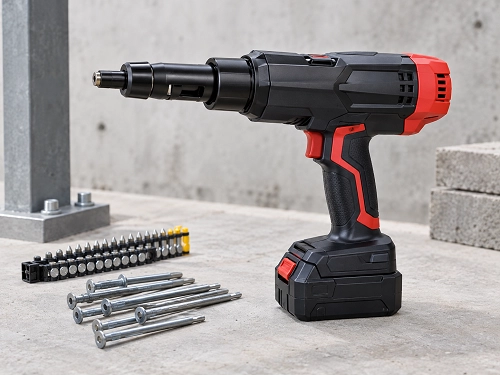
A battery actuated fastening tool drives pins into concrete and steel using stored electrical energy instead of a powder load or a gas cartridge. For contractors, that means no consumables to buy, store, or dispose of. For distributors and OEM buyers, it means a tool that is easier to place on restricted sites, but one that has to be specified carefully.
The energy source changes more than the power cord. A powder-actuated tool takes its energy from a load, and the operator chooses among color-coded power levels. A battery actuated tool converts battery energy into a driving stroke through an electromechanical drive. Designs vary between manufacturers, and Jinhow's page does not publish its internal mechanism, so ask for it if it matters to your application.
The practical consequence is consistency. Jinhow describes calibrated penetration depth across different base materials, which reduces re-driving and rework. The trade-off is that the tool's energy ceiling is fixed by design, rather than adjusted by swapping loads. That is why the rated limits matter so much.
| Factor | Battery actuated | Powder actuated | Gas actuated |
|---|---|---|---|
| Energy source | Rechargeable lithium-ion battery | Powder loads, color-coded by power level | Gas fuel cell (Jinhow's kit also includes a rechargeable battery) |
| Consumables per shot | Pin only | Pin plus one load | Pin plus gas from the cell |
| Power control | Depth adjustment; energy ceiling set by the design | Selectable through load level | Adjustable power setting |
| Site logistics | No combustion; battery charging only | Loads need controlled storage and handling | Fuel cells need storage and disposal |
| Routine upkeep | Battery care and mechanism inspection | Barrel, firing pin, and return mechanism checks | Combustion chamber cleaning and seal checks |
| Best fit | Repetitive fastening in restricted or occupied spaces | Demanding fastening into hard substrates | Cordless, fast-cycling, high-volume work |
Compiled from Jinhow's powder actuated tool and gas actuated fastening tool pages and general industry practice. Confirm figures against each tool's data sheet.
Jinhow lists construction, installation, shipbuilding, power generation, and mining as target uses. The pattern is the same in each: repeated fastening, limited access to power or fuel, and a site where handling explosive loads or gas adds paperwork. The table below matches common tasks to what to check.
| Application | Base material | Why a battery tool suits it | Check before use |
|---|---|---|---|
| Steel stud and track | Concrete floors and ceilings | High repetition, no consumables | Pin length against slab hardness |
| Conduit, cable trays, pipe brackets | Reinforced concrete | Consistent depth means fewer re-drives | Pins can deflect off rebar; test on scrap first |
| Facade, cladding, insulation boards | Structural steel | Cordless use at height | Washer type and pull-through resistance |
| Shipbuilding and marine fit-out | Steel plate | No loads or gas in enclosed compartments | Plate thickness limits; pin corrosion protection |
| Power generation and substations | Concrete and steel | Mobility around equipment bases and cable routes | Site permit and hot-work rules |
| Roof decking and purlins | Structural steel | Fast, repeatable placement | Load-bearing connections must follow the engineer's specification |
Jinhow's page lists steel, concrete, and structural substrates but does not publish an energy rating or a maximum pin length. Treat that as the first question for any supplier. Thick structural steel and high-strength concrete are where an under-specified tool fails, and where a higher-energy powder-actuated system may still be the right choice.
Jinhow states that the tool works with its own range of drive pins for concrete, steel deck, and composite substrates. Pins built for powder-actuated calibers are not automatically interchangeable. Confirm the exact pin model against the tool before ordering, and browse the drive pin range with your supplier's compatibility list beside you.
Driving a hardened pin into steel or concrete can still throw fragments or sparks. In classified or hot-work areas, a battery tool does not automatically satisfy the permit. Confirm with the site safety officer, and do not assume a tool is approved for explosive atmospheres unless its documentation says so.
Lithium-ion cells deliver less power when cold, and runtime drops accordingly. For winter or cold-storage work, ask for cold-temperature performance data and keep spare packs warm until needed.
Jinhow lists an anti-blank-fire safety system that prevents actuation unless the nose is fully pressed against the work surface, plus tool-free depth adjustment. Those are design features. Safe use still depends on procedure.
OSHA's rule for powder-actuated tools, 29 CFR 1926.302(e), is a useful baseline. It requires operators to be trained on the specific tool, safety devices to be tested each day before loading using the manufacturer's method, defective tools to be removed from service, and protective equipment to be worn. Battery actuated tools do not use loads and are not named in that section, so confirm applicability with your safety officer and local regulator. OSHA has published interpretation letters on how the section applies to gas-actuated tools, which shows how regulators approach related tool types.
Two points are easy to miss. First, CE marking is in most cases a manufacturer's declaration, while UL and GS involve third-party bodies. Ask for the Declaration of Conformity and for certificate numbers that you can verify with the issuer, and confirm they cover the exact model you are buying. Second, lithium-ion battery packs are regulated dangerous goods in transport. Ask for the UN 38.3 test summary for the pack before you plan shipments.
| Item | What Jinhow's product page states | What to request |
|---|---|---|
| Drive energy and pin range | Compatible with Jinhow drive pins for concrete, steel deck, and composite | Rated energy, minimum and maximum pin length, substrate limits with test data |
| Battery platform | High-capacity lithium-ion, shared across several tool models | Voltage, capacity, shots per charge, charge time, cold-weather rating, UN 38.3 summary |
| Durability | High wear-resistant alloys; validated for tens of thousands of drive cycles (manufacturer's statement) | Test report, service-life definition, spare parts list |
| Safety system | Anti-blank-fire; nose must be fully depressed | Full description of interlock logic and drop-event behavior |
| Certification | CE, UL, and GS | Declaration of Conformity and verifiable certificate numbers for the exact model |
| OEM and ODM | Body color, logo, interface, safety configuration, packaging, multilingual manuals | Minimum order quantity, sample lead time, tooling cost, documentation format |
Jiaxing Jinhow Import and Export Co., Ltd., which trades as Jinhow Technology (Zhejiang) Co., Ltd., was established in 2007 and is based in Jiaxing, Zhejiang, close to Shanghai, Hangzhou, and Ningbo. The company profile cites more than 18 years of experience in powder-actuated fastening systems, including drive pins, powder loads, tools, screws, and anchors, with customers in more than 30 countries. Jinhow offers OEM and ODM services and accepts small orders. Browse the battery-powered fastening tool category or read more in the industry news section.
No. Jinhow states that its tool runs on a rechargeable battery and needs neither powder charges nor gas cartridges.
Not necessarily. Compare the rated pin length and substrate limits with the job. Where thick steel or very hard concrete is involved, confirm the rating first.
The absence of combustion and lower noise are advantages in tunnels, data centres, and occupied interiors, according to Jinhow. Protective equipment and site permits still apply.
Gun body color, logo, interface specifications, safety configuration, packaging, and multilingual manuals, with engineering support from design through mass production.